
Business Is Making A Philosophical Shift To Value Creation.
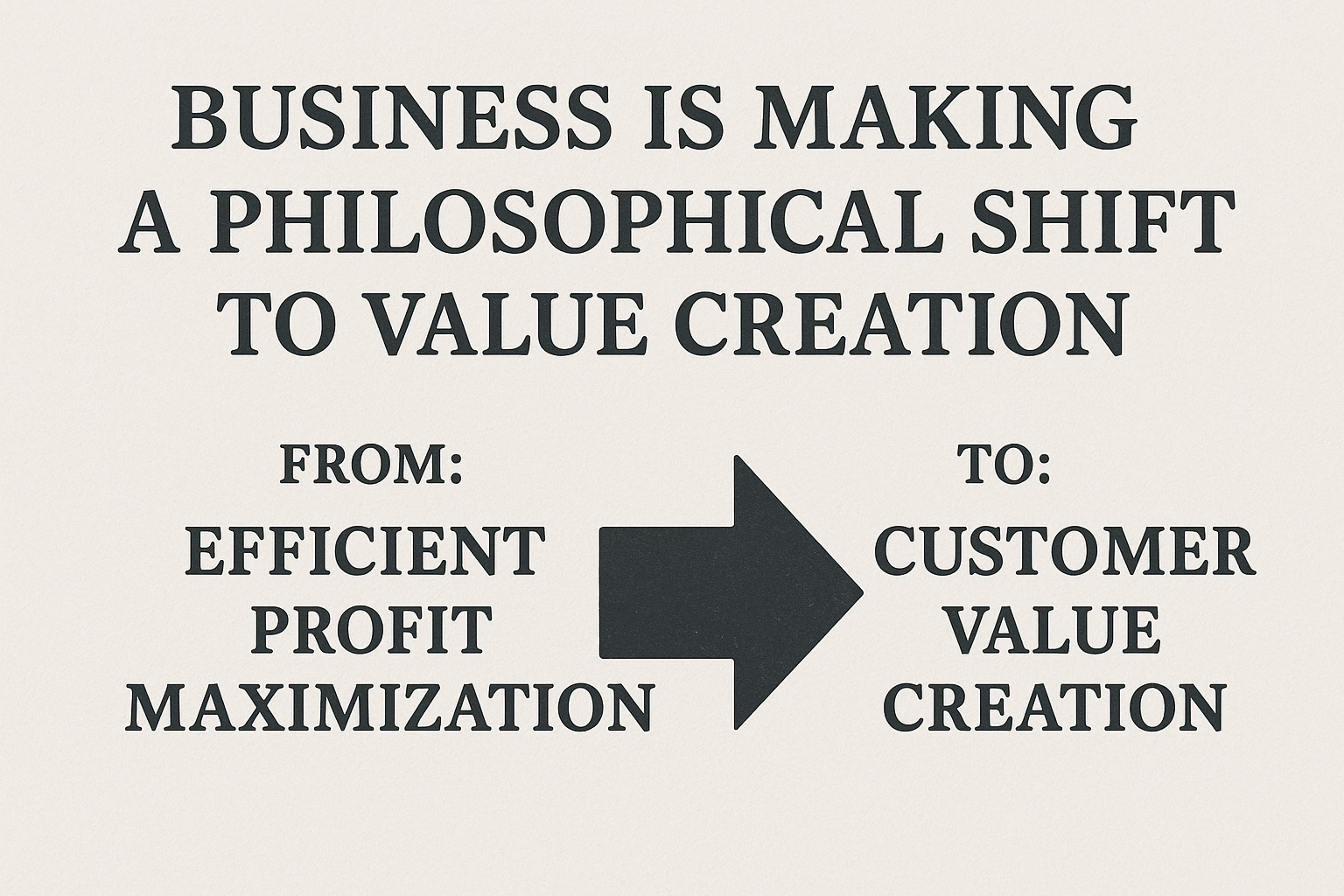
Business is undergoing a philosophical change. It is subtle, incomplete, and uneven — but it is real. And it may be decisive in changing the reputation of corporations and capitalism from exploitative and extractive to ethical, creative, and elevating.
The shift can be described simply.
From: efficient profit maximization
To: customer value creation
In philosophy textbook terms, it is a move away from logical positivism and toward subjectivism — a transition that opens the door to freedom, creativity, and genuine service to others.
How Business Learned to Think Like a Machine
In her recent monograph Why Context Matters: Where Did Anglo-American Philosophy Go Wrong?, Alicia Juarrero locates a central mistake in European logical positivism: the belief that reality is only what can be measured, modeled, and verified through science and mathematical logic. Under positivism, emotion, aesthetics, meaning, and subjective value are not merely secondary — they are excluded. Only physics counts.
That philosophy found a welcoming home in American business education.
The discipline of management science traces its modern origins to Frederick Taylor’s The Principles of Scientific Management (1911). Taylor’s ambition was explicitly mathematical: to maximize physical output per unit of human labor. His method was crude but revealing. Measure a group of workers performing the same task, identify the top performer, declare that level of output the “standard,” and compel everyone else to meet it. Efficiency, defined numerically, became the supreme virtue.
This way of thinking scaled quickly. After the two world wars, European academics — many steeped in positivist philosophy — migrated to American universities, including newly influential business schools. At the University of Chicago, Herbert Simon recalled in his memoir that positivism was the “dominant, perhaps exclusive, religion” among his intellectual circle. Simon’s Administrative Behavior (first published in 1945) became a foundational text for business education worldwide.
The title tells the story. Business was framed as administration — a system to be engineered, optimized, and controlled. Management scholars would develop universal tools and techniques to improve performance, primarily through efficiency and cost reduction. Innovation, imagination, empathy, and customer experience were peripheral at best.
That curriculum still dominates business education today. While relatively few people attend business school, its worldview sets the norms for how managers manage — and how employees are treated and customers are regarded. In that sense, much of modern business has been living inside a positivist philosophy it never consciously chose.
The Emergence of a Different Philosophy
There is, however, an alternative — and it is gaining ground.
In philosophy, it is called subjectivism. In business, it goes by a more practical name: value creation.
Value creation starts from a radically different premise. The purpose of business is not to optimize administrative efficiency, but to be excellent at serving customers. Value is defined as the satisfaction people experience when their needs and desires are met. That satisfaction exists in the mind of the individual customer. It is subjective. It varies from person to person. And it cannot be reduced to equations.
This immediately changes everything.
The first pillar of value creation is empathy: the capacity to understand how customers think, feel, and evaluate their own lives. Empathy owes more to imagination and emotion than to logic and calculation. Under value creation, emotion is not a nuisance variable — it is central.
The goal is not merely transaction, but how customers feel about their exchange with a brand or company.
How good does it feel to ask Google’s AI mode a question and receive clarity?
How good does it feel for a data center builder to secure scarce Nvidia GPUs?
How good does it feel when an Amazon package arrives exactly as expected — and how reassuring is it to return it effortlessly, no questions asked?
These experiences were not designed by optimizing a spreadsheet. A purely positivist analysis might easily reject them as inefficient. Yet they emerge naturally from empathic insight into what would make customers’ lives better.
Why Value Creation Wins — Economically and Ethically
Value creation produces a powerful — and often misunderstood — economic result.
Revenue is the clearest signal of value creation, because customers voluntarily pay for experiences they expect to be worthwhile. When expectations are met or exceeded, customers return. They buy more. They recommend. Trust forms.
Trust, in turn, commands a premium. Margins improve. Profits grow. And those profits can be reinvested in better service today and deeper innovation tomorrow. The system becomes recursive: more value leads to more revenue, which funds more value creation.
This is not charity. It is a superior economic logic.
Value creation also scales. It scales when companies meet universal needs — for knowledge, convenience, computing power, productivity, health, or entertainment. It specializes when unexpected value is delivered to selective customers — whether through fashion, rarity, personalization, or exceptional service. Between those extremes lie countless viable markets.
The philosophy works everywhere.
The Stakes for Capitalism
There is reason to believe this philosophical shift is arriving just in time.
Younger generations are deeply skeptical of corporations and capitalism. Surveys by firms such as Gallup consistently show low levels of trust among Gen Z and Millennials. In one recent Gallup study, only 17% of Gen Z respondents said they had “quite a bit” or “a great deal” of trust in large tech companies. That emotional disengagement poses a genuine threat to the legitimacy of the market system — a system that has, undeniably, delivered unprecedented prosperity.
But the story is not finished.
Value-creating companies generate not just trust, but affection — even love. And who doesn’t love experiencing better outcomes, more convenience, greater empowerment, and rising quality of life over time?
The philosophical shift from efficiency-driven administration to empathic value creation has the potential to rehabilitate capitalism from the inside. Not by rhetoric or regulation, but by lived experience.
This is the future of business — and it will be built one act of value creation at a time.
_____________________________
Learn the value creation mindset at The Value Creators.