The Concept of Management Is a Tool of Control Culture

The concept of management is not a natural law. It’s a cultural artifact—devised in one age, taught and normalized in the next, and steadily hardened into something unquestionable. Its rules, norms, and assumptions regulate how people behave inside firms and shape what every generation comes to accept as “how things are done.”

Today’s management, especially the version taught in business schools, remains largely what it was built to be: a technology of control.

The Value Creators is a reader-supported publication. To receive new posts and support my work, consider becoming a free or paid subscriber.

The Cultural Origins of Control

While “management” has ancient roots—oikos and nomos in Ancient Greece, household and rule—the modern managerial worldview emerged in the mid-19th century. Entrepreneurial ventures had expanded far beyond the capacity of their founders to control. But control required a system.

The system these founders borrowed was from the Prussian military. Its core aim was simple: enable generals to control distant soldiers through structure, hierarchy, and process. What worked for armies became the template for firms. Military precision became bureaucratic control.

Management evolved in technique, but not in spirit. It never transcended its cultural origin. The basic model remains: a hierarchy in which those above direct those below; centralized planning that allocates projects and budgets; job descriptions that bind individuals to narrow behavioral expectations. Management controls actions and holds individuals responsible for outcomes—despite denying them freedom over means.

The Assumption Behind It All: People Can’t Be Trusted

Frederick Taylor made this explicit. In The Principles of Scientific Management (1911), he presented management as a science of efficiency grounded in laws and rules. His fundamental claim was that workers naturally loiter (he called it “soldiering”) unless managed tightly. The solution, he believed, was to impose method, measurement, and oversight.

Business schools later rebranded this managerial authority as “leadership,” and elevated managers into a professional class. Peter Drucker added the gloss of “knowledge work,” but the hierarchical relationship remained intact: managers supervise; workers comply. Management became a cultural domain—a liberal art, Drucker called it —but still a structure designed to control.

James Burnham saw where this was heading: a Managerial Class ruling in place of owners or entrepreneurs. In his view, capitalism would be hollowed out by a new post-capitalist managerial order—especially within the state. He was right about government: bureaucracy expands endlessly, producing more rules and more enforcers with no mechanism for reversal.

But outside the state, something unexpected is happening. The managerial class is weakening.

The Hierarchy Is Dissolving

Private-sector firms are discovering that the traditional multi-layer hierarchy is an anchor, not an engine. Complexity can no longer be handled by piling managers on top of managers. Even large corporations now acknowledge this. The Society for the Advancement of Management reports that firms such as Google, Amazon, and Estée Lauder have dramatically reduced management layers. The average manager-to-employee ratio has jumped from 1:5 to 1:15 in just a few years.

Fewer layers mean faster decisions, less sludge, and a shift in culture. When individuals stop seeking permission and compliance no longer serves as the currency of survival, creativity resurfaces. Energy resurfaces. The question becomes unavoidable: Why have managers at all?

The Rise of People-Centered Organization

Some companies asked this question decades ago. Ricardo Semler, inheriting his family company, Semco, found a dispirited workforce—precisely what hierarchical control invariably produces. His solution: trust. He dismantled layers, handed authority to workers, and institutionalized “workplace democracy.” Semco thrived—not despite the absence of traditional management, but because of it.

Semler showed that people do not need to be managed. They need to be free.

Digitization Is Making Managers Redundant

Another force weakening management is digitization. Processes once overseen by managers are now encoded in software—consistently, transparently, and without bureaucratic drag.

The online fashion retailer Handu exemplifies this shift. Its structure has three parts:

  1. Self-managed front-end teams: small, autonomous units (designer, marketer, technician) that run their own online stores. Successful teams receive more resources; unsuccessful ones dissolve.

  2. A fully automated middle layer: ordering, payments, inventory, marketing, logistics—100% digital.

  3. A back-end of sustaining assets: factories, warehouses, servers, and the databases that support fan communities.

Above it all sits a tiny strategic group that adjusts only when the data calls for it. Harvard Business Review labels this “digitally enhanced directed autonomy.” Whatever the name, the point is clear: management, as traditionally conceived, is unnecessary.

Autonomy Works Better Than Control

Autonomy sounds risky to those steeped in managerial culture. Without bosses, who governs? Who controls?

The Morning Star Company demonstrates the answer: no one must control if everyone commits. Morning Star has no managers, no titles, no hierarchy. Instead, every team member negotiates a CLOU—Colleague Letter of Understanding—that specifies the services they will provide to others and the commitments they will uphold. Two principles govern the entire firm:

  1. No one may coerce another.

  2. Everyone must honor their commitments.

The result is decades of productive harmony in a billion-dollar enterprise. Autonomy is not chaos. Autonomy is coordination without coercion.

Teams Replace Departments

Software changed the nature of work. The unit of action is no longer the department but the team. Teams form fluidly across old boundaries—marketing with production, sales with finance, R&D with customer experience—because customers don’t care about internal structures.

Teams, not hierarchies, respond to market signals.

And when the team becomes the fundamental organizational unit, the org chart becomes irrelevant—along with the HR machinery that maintains it.

Flow Replaces Implementation

When teams work well, they operate in what Professor Adrian Bejan calls flow: systems naturally evolving to remove constraints and increase freedom of movement.

Flow eliminates barriers—structural, conceptual, organizational, and human. Silos erode. Bad processes vanish. Power relationships flatten. Barriers dissolve wherever freedom accelerates value creation.

Entrepreneurship Becomes the Energy of the Firm

What flows through an organization, once barriers fall, is entrepreneurial energy: the search for new value for customers. Firms that embrace flow—and remove the managerial obstacles to it—grow, adapt, and innovate with an ease that managerial firms can’t match.

Management adds layers. Flow removes them.

Management imposes structure. Entrepreneurship breaks it open.

The two are opposites.

Concepts Are Choices—So We Must Choose Again

Management persists not because it works, but because it is a concept we inherited, reinforced by generals, Taylorists, theorists, and business schools. Concepts feel inevitable when repeated enough. But they are constructs—and constructs can be replaced.

We can choose different concepts: freedom, flow, creativity, autonomy, networks, and entrepreneurship. Concepts that fit the world we actually live in, rather than the world of Prussian armies and 19th-century factories.

The concept of management has served its cultural purpose.

Now it stands in the way.

It’s time to let it go.

____________________________________________________________________________


The Value Creators is a reader-supported publication. To receive new posts and support my work, consider becoming a free or paid subscriber.

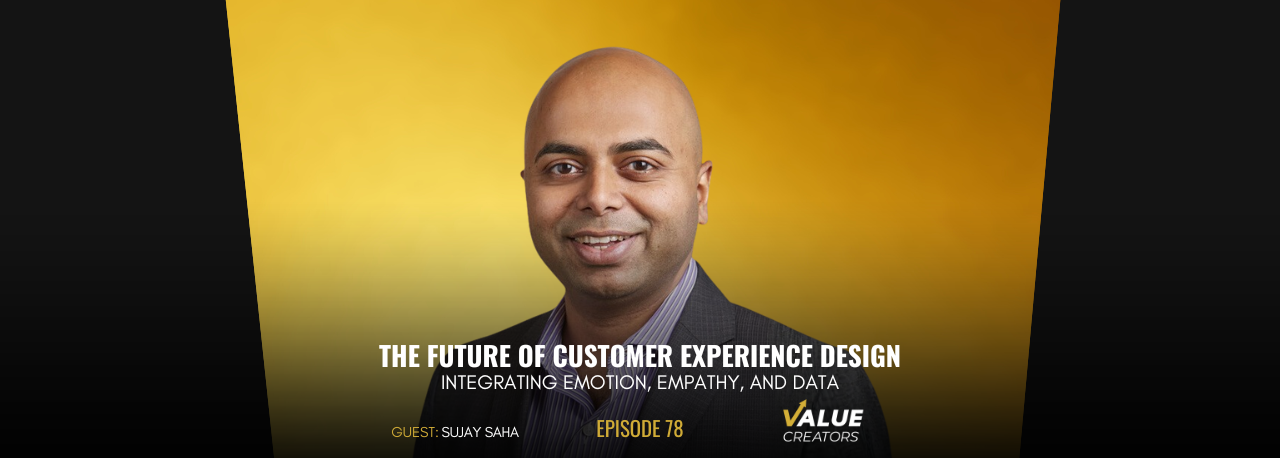
Episode #78. The Future of Customer Experience Design: Integrating Emotion, Empathy, and Data with Sujay Saha

Listen to the episode here:

Customer experience is the new gold — valuable, and becoming more valuable.

In this episode of The Value Creators Podcast, Hunter Hastings speaks with Sujay Saha, CEO of Cortico-X, a leader in experience design, to explore how the world’s most forward-thinking companies are reshaping customer experience in the AI era.

Sujay introduces a new discipline — experience-led architecture — where strategy, design, and technology converge to create experiences that reflect customer needs instead of reacting to them. He also explains how to measure the true ROI of experience, proving its financial impact beyond customer satisfaction scores.

Finally, he shows how AI is changing the way organizations understand people — blending data with emotion to design interactions that drive loyalty, trust, and long-term value.

Key Insights:

  • Businesses should design experiences, not just processes. Experience-led businesses grow faster because they see every interaction as a design opportunity.
  • Prove the ROI of experience. Customer experience is measurable — and profitable — when tied to clear business outcomes.
  • Blend objective data and subjective emotion. The future of business intelligence is human intelligence — understanding not just what customers do, but how they feel, and why.

If you want to future-proof your business around people and their experiences — not just products and processes — this episode is essential listening.

Resources:

➡️ Learn What They Didn’t Teach You In Business School: The Value Creators Online Business Course

Connect with Sujay Saha on LinkedIn

Learn more about Cortico-X

Connect with Hunter Hastings on LinkedIn

Subscribe to The Value Creators on Substack

Knowledge Capsule

1. Experience Design Is Strategic, Not Cosmetic

  • Sujay emphasizes that customer experience (CX) begins at the strategic level, not as a marketing afterthought.
  • True experience design shapes how customers feel, decide, and remain loyal.
  • Companies must move from transactional design to emotional design.

2. Experience-Led Architecture: A New Operating Model

  • This framework embeds customer experience at the core of every business function.
  • It aligns leadership, operations, and culture around delivering consistent emotional value.
  • Experience becomes the organizing principle — not the end result.

3. Measuring ROI of Experience

  • Sujay argues that CX must prove its value in measurable business terms.
  • Metrics like retention, engagement, extended cash flows, and share of wallet reflect real experience ROI.
  • The new standard is “Return on Experience” (ROX), combining emotional and financial performance.

4. Emotion + Data = Human Insight

  • Data reveals patterns, but emotion explains why they matter.
  • AI can integrate sentiment analysis with behavioral data to uncover deeper motivations.
  • The most innovative companies use this blend to anticipate rather than react.

5. Designing for Anticipation, Not Reaction

  • Reactive service is outdated — proactive experience is the new expectation.
  • AI enables predictive understanding of customer needs.
  • When brands anticipate emotional context, satisfaction turns into advocacy.

6. The Experience Economy Evolves

  • Customers don’t just buy products — they buy experiences and meaning.
  • Businesses that design memorable emotional moments win long-term loyalty.
  • Experience has become the key differentiator in competitive markets.

7. Aligning Brand Promise with Experience Delivery

  • Brand is not what a company says; it’s what a customer feels.
  • Experience-led organizations ensure that brand messages match lived interactions.
  • Misalignment between promise and experience destroys trust and value.

8. The Role of AI in Human-Centered Design

  • AI provides insight at scale but must remain guided by human empathy.
  • Sujay warns that over-automation can strip emotion from interaction.
  • The goal is “AI with EQ” — using intelligence to enhance connection, not replace it.

9. Redesigning Business Architecture Around People

  • Experience-led architecture reimagines how teams, data, and decisions are structured.
  • Every department becomes accountable for the emotional impact of its work.
  • CX moves from a department to an operating system.

10. The Measurement Shift: From KPIs to RPI

  • Traditional KPIs measure output; RPI (Return on People and Interaction) measures outcomes.
  • RPI integrates emotional engagement metrics into business dashboards.
  • Leaders can now link experience quality directly to profit growth.

11. Leadership in the Experience Era

  • Leaders must think like designers — curious, empathetic, and iterative.
  • Experience-driven leadership focuses on how decisions feel to customers and teams.
  • CX leadership blends analytical thinking with storytelling and vision.

12. Future-Proofing Through Experience

  • In a data-saturated world, emotional intelligence becomes the ultimate differentiator.
  • The best businesses will compete on understanding, not just efficiency.
  • Experience-led innovation builds resilience, relevance, and enduring value.