Replacing the MBA: Venture Mode, Entrepreneurship, and the Future of Business Education

Following principles of business administration is the path to disaster for your business or any business. Yet business administration is what’s taught in business school and revered as the highest goal of management. We need to change how we think about business, which requires changing our mental model.

Entrepreneurial leadership is the new mental model..

In Part 2 of the special 3-part series of The Value Creators Podcast featuring the alternative approach to the business administration methods taught in MBA school, Venture Mode, Hunter Hastings and co-author Mark Packard continue their exposition of what comes after traditional business administration. Together, they examine how business schools institutionalize bureaucracy, why reform from inside the system is nearly impossible, and how administration mode crowds out entrepreneurial leadership.

They introduce a radically different alternative: the Master of Business Enterprise (MBE)—a new model of business education grounded in entrepreneurship, experimental learning, uncertainty, and real-world value creation. The conversation explores why customers—not processes or analytics—must be at the center of business thinking, and why skills like empathy, judgment, creativity, and tenacity are essential for navigating uncertainty.

This episode challenges long-held assumptions about business models, what business education should teach, who it should serve, and how entrepreneurial leaders are truly developed.

Key Insights:

  • Why the MBA reinforces administration mode and systematically underproduces entrepreneurial leaders.
  • How exploration, discovery, and customer-centered value reshape business education.
  • Why entrepreneurship must be learned through practice, empathy, and real-world experience.

Resources:

➡️ Learn What They Didn’t Teach You In Business School: The Value Creators Online Business Course

Connect with Mark Packard on LinkedIn

Get the book “Venture Mode: Escape the Administration Trap”

Connect with Hunter Hastings on LinkedIn

Subscribe to The Value Creators on Substack

Knowledge Capsule

1. Administration Mode Is Institutionalized Through Business Schools

  • How did we fall into the administration trap? Because all business education trains students in a scientific, administrative approach to management.
  • Graduates carry administration mode into organizations, reinforcing bureaucracy and control systems.
  • This institutional pipeline makes entrepreneurial leadership increasingly rare. It is actively suppressed.

2. The MBA Teaches Management, Not Entrepreneurship

  • The MBA curriculum focuses on efficiency, optimization, and process control.
  • Entrepreneurship requires creativity and judgment under uncertainty, not rule-following.
  • Administrative training limits adaptability in dynamic markets.

3. Accreditation Reinforces Bureaucracy

  • Business schools must teach administration to remain accredited.
  • The requirements of the business administration cartel discourage experimentation and reform.
  • Breaking from administration mode often means losing institutional legitimacy.

4. Reforming Business Education From Within Is Unlikely

  • Universities are among the most administrative organizations in existence.
  • Structural incentives favor compliance over innovation.
  • Entrepreneurship must emerge outside traditional academic systems.

5. The Master of Business Enterprise (MBE) is an Alternative

  • The MBE shifts focus from administration to entrepreneurship.
  • It emphasizes uncertainty, value creation, and real-world problem solving.
  • The goal is developing entrepreneurial leaders, not administrators.

6. Subjectivism as the Foundation of Entrepreneurship

  • People are conscious, thinking agents—not controllable automatons.
  • Value is subjective – formed in experience – and must be understood from the customer’s perspective.
  • Businesses must learn from people rather than attempt to control them.

7. Customers Are the Central Focus of Value Creation

  • Understanding customer experiences requires emotion and empathy, not analytics alone.
  • Entrepreneurs must learn how customers think and feel.
  • Deep customer understanding drives innovation and growth.

8. Entrepreneurship Operates Under Genuine Uncertainty

  • Future customer choices cannot be predicted with data or statistics.
  • Administrative tools fail in uncertain, dynamic environments.
  • Entrepreneurs must design adaptive systems rather than rigid plans.

9. Entrepreneurial Skills Can Be Developed, Not Standardized

  • Skills like empathy, judgment, and creativity can be nurtured through practice.
  • Entrepreneurship is not a checklist or blueprint or method.
  • Learning requires experience, reflection, and iteration.

10. Empathy Is a Trainable Entrepreneurial Skill

  • True empathy means understanding experiences from the customer’s point of view.
  • Surveys and surface-level research are insufficient.
  • Entrepreneurs must immerse themselves in customers’ lived experiences.

11. Judgment, Creativity, and Tenacity Matter More Than Analytics

  • Statistical analysis cannot guide decisions about unknown futures.
  • Better judgment comes from understanding uncertainty and knowledge gaps.
  • Tenacity grows when entrepreneurs are prepared for downside risks.

12. Experiential Learning Is Essential to Entrepreneurship

  • Entrepreneurship is learned by doing, not by lecture alone.
  • Practicum and apprenticeship models accelerate skill development.
  • Real projects create real learning under real constraints.

Timestamps

Chapters:

00:00 – Why Business Schools Produce Administrators, Not Entrepreneurs
02:10 – How the MBA Institutionalizes Administration Mode
04:50 – Why Accreditation Prevents Real Reform
07:15 – Introducing the Master of Business Enterprise (MBE)
09:50 – Subjectivism, Customers, and Value Creation
12:45 – Why Entrepreneurship Cannot Be Reduced to Checklists
15:40 – Teaching Empathy, Judgment, and Creativity
19:20 – Learning Entrepreneurship Through Practice
23:30 – Who Is the Real Customer of Business Education?
31:45 – The Future of Entrepreneurial Leadership

Venture Mode: How Businesses Can Escape the Administration Trap with Mark Packard

The most damaging error for a business is to run in administration mode. It’s the worst way to run a business. Yet it’s given the highest accolade: the greatest credential you can get is an MBA, a master’s in business ADMINISTRATION.  Administration mode is parroted in every business book, business periodical, and online business education. Administration is a trap baited with best practices, process lock-in, inflexible resource allocation, risk aversion, and impossibilities like strategic planning and financial forecasting.  

To save American business from the administration trap, Mark Packard and Hunter Hastings wrote a book titled Venture Mode – the alternative to administration mode. In this episode of The Value Creators Podcast, Mark and Hunter talk about why administration is so deeply flawed in the context of today’s fast-paced, innovative economy — and what to do instead.

Together, they introduce a fundamentally different operating model that replaces bureaucracy, internal control, and prediction with entrepreneurial leadership and relentless customer value creation. In this first of three special episode of The Value Creators podcast, the authors explain how administrative thinking became institutionalized through business schools and management science — and why it is quietly destroying productivity, innovation, and growth.

Key Insights:

  • Administration mode turns off the entrepreneurial engine and replaces value creation with value replication.
  • Venture mode shifts focus from internal processes and control to continuous adaptation around customer value.
  • Entrepreneurship is not limited to startups — it is a scalable economic function essential for long-term growth.

If organizations aim to survive and thrive in uncertain markets, they must escape administration mode and rediscover entrepreneurship as their core operating logic.

Resources:

➡️ Get the book “Venture Mode: Escape the Administration Trap”

Connect with Mark Packard on LinkedIn

Connect with Hunter Hastings on LinkedIn

Subscribe to The Value Creators on Substack

Knowledge Capsule

 Administration mode dominates modern organizations

  • Most organizations today operate primarily in administration mode rather than entrepreneurial mode.
  • Administration mode prioritizes control, efficiency, and internal processes over value creation.
  • This operating model becomes more entrenched as organizations grow and mature.

2. Administration mode suppresses entrepreneurship

  • Entrepreneurial behavior declines when rules, procedures, and approvals dominate decision-making.
  • Employees are incentivized to follow processes and rules instead of solving customer problems.
  • Innovation is perceived as “too risky” and is discouraged within administrative systems.

3. Bureaucracy is a learned behavior

  • Organizations are not naturally bureaucratic; bureaucracy is taught and and built and reinforced over time.
  • Business education plays a central role in normalizing administrative thinking.
  • Leaders replicate the systems they were trained to believe are “best practices.”

4. Business schools imported positivism into management

  • Management theory borrowed scientific methods from the natural sciences.
  • Positivism assumes organizations can be measured, predicted, and optimized mechanically.
  • This worldview ignores the subjective, dynamic and sometimes unpredictable nature of human action.

5. Positivist thinking fails in economic systems

  • Human beings make choices based on judgment, not fixed variables.
  • Markets evolve through learning, adaptation, and experimentation.
  • Predictive models break down in complex, uncertain environments.

6. Administration prioritizes replication over discovery

  • Administrative systems are designed to repeat known processes efficiently.
  • Discovery of new value is seen as disruptive rather than essential.
  • Over time, organizations become optimized for the past instead of the future.

7. Venture mode offers an alternative operating logic

  • Venture mode treats the firm as a portfolio of entrepreneurial initiatives.
  • Decision-making focuses on learning, experimentation, and adaptation.
  • The organization remains flexible and responsive to market signals.

8. Venture mode centers on customer value creation

  • Customer value becomes the primary organizing principle of the firm.
  • Insights flow from customer experiences rather than internal reports.
  • Success is measured by the value delivered and experienced, not by process compliance.

9. Entrepreneurship is a scalable business function

  • Entrepreneurship is not limited to startups or founders.
  • Large organizations require continuous entrepreneurial activity to grow.
  • Venture mode enables entrepreneurship to persist at scale.

10. Loyalty is conditional on ongoing value creation

  • Customers do not remain loyal without continued value improvement.
  • Past success does not protect firms from competitive displacement.
  • Organizations must constantly earn customer preference through innovation.

11. Bureaucracy imposes massive economic costs

  • Administrative overhead absorbs resources that could fuel innovation.
  • Productivity declines as organizations add layers of control.
  • Economic growth slows when entrepreneurship is systematically constrained.

12. Leadership must shift from control to value creation

  • Leaders must let go of prediction and embrace uncertainty.
  • Judgment and experimentation replace rigid planning and forecasts.
  • Venture leadership restores entrepreneurship as the engine of growth.

Chapters:

00:00 – Why administration is a terrible way to run a business
02:10 – Introducing Venture Mode and the administration trap
03:05 – Manager mode vs. entrepreneurial leadership
06:12 – Why bureaucracy kills innovation and agility
09:01 – How positivism shaped business education
14:18 – The real economic cost of bureaucracy
19:12 – Entrepreneurship as the source of growth
22:35 – What venture mode really means
26:08 – Entrepreneurship beyond startups
28:38 – The mindset shift from administration to venture mode

Value Creation vs. Value Capture: Reframing the Purpose of the Firm with Ashutosh Garg

What is the real purpose of the firm: creating value or capturing it?

In this episode of The Value Creators Podcast, Hunter Hastings is joined by Ashutosh Garg to explore one of the most fundamental misunderstandings in modern business thinking—the confusion between value creation and value capture. While traditional economic and management frameworks emphasize profit extraction, pricing power, and competitive positioning, Ashutosh explains why these ideas can mislead firms away from their true role in the economy.

The conversation reframes the firm as a value creation system, where profit is not the goal but the result of successfully serving customers. Together, they unpack how focusing on value capture leads to short-term thinking, distorted incentives, and weakened customer relationships, while a value creation mindset unlocks long-term growth and resilience.

Key Insights:

  • Why value capture is often misunderstood as the goal of the firm rather than a consequence of value creation
  • How profit emerges as a signal of successfully serving customers—not as an objective to optimize directly
  • Why firms that focus on customer value outperform those focused on extraction, pricing, and competitive advantage

If you want to rethink strategy, profit, and the role of business in society, this episode offers a powerful shift in perspective.

Resources

➡️ Learn What They Didn’t Teach You In Business School: The Value Creators Online Business Course

Connect with Ashutosh Garg on Facebook

Connect with Hunter Hastings on LinkedIn

Subscribe to The Value Creators on Substack

Get your copy of Venture Mode: Escape The Administration Trap By Finding and Unleashing Entrepreneurial Leaders

Knowledge Capsule

1. The firm exists to create value, not to capture it

  • The primary role of a business is to create value for customers.
  • Value capture occurs only after value has been successfully created.
  • Confusing the two leads to flawed strategies and poor outcomes.

2. Profit is a result, not a goal

  • Profit signals that customers perceive value in what the firm offers.
  • Attempting to optimize profit directly distorts decision-making.
  • Firms should focus on value creation and allow profit to emerge.

3. Value capture thinking leads to short-termism

  • Firms focused on extraction prioritize immediate financial outcomes.
  • This often results in underinvestment in long-term capabilities.
  • Short-term gains frequently come at the expense of future value.

4. Pricing power is not a substitute for value creation

  • Raising prices without increasing value erodes customer trust.
  • Sustainable pricing depends on delivering superior customer outcomes.
  • True pricing power comes from perceived value, not market manipulation.

5. Customers determine value, not the firm

  • Value is subjective and defined by the customer’s experience.
  • Firms must learn how customers perceive benefits and trade-offs.
  • Value creation requires continuous alignment with customer needs.

6. Competition is secondary to customer focus

  • Competing with rivals can distract from serving customers.
  • The real objective is to create unique value for specific customers.
  • Firms succeed by differentiation through value, not by imitation.

7. Value creation requires continuous learning

  • Customer preferences evolve and require constant adaptation.
  • Firms must learn through feedback, experimentation, and iteration.
  • Static strategies fail in dynamic environments.

8. Metrics can distort behavior if misapplied

  • Financial metrics often emphasize capture over creation.
  • Overreliance on metrics can lead to gaming and misalignment.
  • Measurement should support learning, not control behavior.

9. Organizations must align incentives with value creation

  • Incentives drive behavior more strongly than stated goals.
  • Rewarding short-term results undermines long-term value creation.
  • Systems should encourage experimentation and customer focus.

10. Value capture emerges from successful exchange

  • Exchange occurs when both parties perceive value in the transaction.
  • Profit reflects the firm’s share of that created value.
  • Sustainable capture depends on continued value delivery.

11. Strategy should center on value, not advantage

  • Traditional strategy emphasizes competitive advantage and positioning.
  • A value-centered approach focuses on solving customer problems.
  • Advantage emerges naturally from superior value creation.

12. Long-term success depends on value orientation

  • Firms that prioritize value creation build stronger relationships.
  • Trust and reputation compound over time through consistent value.
  • Long-term resilience depends on staying aligned with customers.

Timestamps

Chapters:

00:00 — Value creation vs. value capture: the core confusion
02:18 — Why profit is not the goal of the firm
05:40 — The dangers of value extraction thinking
09:05 — Pricing power vs. real customer value
12:30 — Who defines value in the market
16:10 — Why competition is the wrong focus
20:25 — Learning, adaptation, and dynamic markets
24:40 — Metrics, incentives, and distorted behavior
29:15 — Rethinking strategy around value creation
34:50 — Final thoughts: building value-driven firms

The Wrong Economics Has Been Running Your Business.

Hunter Hastings & Mark Packard · from Venture Mode, releasing May 5, 2026

What passes for economic thinking in most firms isn’t economics at all. It’s central planning — and it’s costing you more than you know.

Capitalism Works. But Not the Way Most Firms Practice It.

The track record of capitalism is extraordinary. Over the past two centuries, it has produced increases in per capita income, life expectancy, material comfort, technological capability, and human freedom that have no parallel in recorded history. Billions of people have been lifted from poverty. Diseases that killed entire generations have been eradicated. The average person today lives a life that the wealthiest monarch of two hundred years ago could not have imagined.

The Value Creators is a reader-supported publication. To receive new posts and support my work, consider becoming a free or paid subscriber.

This achievement rests on a specific institutional foundation: the firm. The firm assembles capital, deploys it in markets, creates value for customers, and earns a return that signals where more capital should flow. The firm is the engine of the capitalist system — the mechanism through which individual initiative, entrepreneurial insight, and customer need find each other and produce something new.

And yet, somewhere along the route of this remarkable journey, an error crept in. An error about what firms are, how they work, and what economics actually says about them. That error has been running most businesses for over a century. It is called central planning — and it has been presented, with remarkable confidence, as sound economic thinking.

It is not. And understanding why it isn’t is the key to understanding what Venture Mode is and why it works.

The economic principles that built capitalism have been quietly replaced, inside most firms, by the principles that capitalism was built to defeat.

How Central Planning Captured the Firm

Central planning is the idea that economic outcomes can be improved by designing and managing them from the top down — by setting targets, allocating resources according to plan, and controlling behavior through rules, metrics, and hierarchy. In the twentieth century, this idea was tested at the scale of entire national economies, with results that are now part of history.

But central planning didn’t only colonize governments. It colonized firms. It arrived wearing different clothes — strategic planning, budgeting cycles, management by objectives, KPI dashboards, organizational hierarchies — but it carried the same fundamental assumption: that the people at the top of a system have enough knowledge, and enough control over outcomes, to design the behavior of everyone below them toward a predetermined result.

This assumption is the foundation of what we call Administration Mode. The firm is treated as a machine. The job of leadership is to optimize the machine’s outputs. The people inside the machine are variables to be managed, not agents to be unleashed. And the customer — the person whose life the firm is supposed to be improving — becomes a data point in a model rather than a sovereign individual whose choices determine everything.

The machinery for this kind of management was codified in business schools starting with Frederick Winslow Taylor’s scientific management principles in the early twentieth century — the idea that business could be engineered for maximum efficiency through carefully derived scientific principles. It was refined into the MBA curriculum, which today trains hundreds of thousands of managers annually in the tools of prediction, control, and metric compliance. And it has been embedded so deeply in corporate culture that most executives don’t recognize it as an ideology at all. They think it’s just how business works.

Administration mode isn’t neutral management practice. It is central planning applied to the firm — and it carries all of central planning’s fundamental flaws.

What Economics Actually Says

True economics — the economics that explains how value is actually created in the world — starts somewhere very different. It starts with the individual.

Every person seeks to improve their circumstances. This is not a controversial claim; it is the universal axiom from which economics begins. People are not passive recipients of outcomes engineered by planners. They are active agents, constantly scanning their environment for opportunities to move from a less satisfactory state to a more satisfactory one. They have desires, preferences, and purposes that are irreducibly their own — subjective, personal, and not fully knowable by anyone else.

When individuals seek to improve their circumstances, they turn to others who can help them do so. And here is where entrepreneurship enters the picture — not as a personality type or a startup strategy, but as an economic function. The entrepreneur is the person who senses what others need, even before those needs are fully articulated, and who assembles the resources, knowledge, and capability to provide it. The entrepreneur doesn’t wait for a market research report to confirm demand. They imagine a better future state for a specific customer and build a path toward it.

This interaction — between an entrepreneur seeking to provide new value and a customer seeking to experience it — is the atomic unit of economic life. It is where value is created. Not in the boardroom. Not in the planning cycle. Not in the budget process. In the moment when a real person chooses to accept a real offer because it genuinely improves their life.

The customer’s willingness to pay is not merely a revenue event. It is a signal — the clearest signal the economic system produces — that value has been created. And the entrepreneur’s profit is not a extraction from the system but a reward for having served it well: for having sensed a need, borne the uncertainty of attempting to meet it, and succeeded.

Value is not produced inside the firm and delivered outward. It emerges in the customer’s world — in the experience of an improved life — and the firm’s job is to make that experience possible.

The Virtuous Circle — and Why Central Planning Breaks It

When this process works as it should, it is a virtuous circle. Individual entrepreneurs serve individual customers. Customers signal their satisfaction through their choices — choosing again, choosing more, telling others. Those signals guide the entrepreneur toward better offerings and guide capital toward more productive uses. Other entrepreneurs, attracted by the signals, enter adjacent spaces and create new offerings that further expand what is possible for customers. Markets emerge from these countless interactions — not as designed outcomes but as emergent properties of millions of individual exchanges, each one a micro-decision about value.

This is how capitalism produces prosperity. Not through planning. Through the distributed intelligence of people pursuing improvement, guided by the feedback of free exchange.

Central planning breaks this circle at every point. It substitutes the judgment of planners for the judgment of customers. It replaces the signal of voluntary exchange with the noise of internal metrics. It directs capital according to predetermined allocations rather than toward its highest and best use as revealed by actual market feedback. And it suppresses the entrepreneurial sensing function — the ability to discover what customers need before they can fully articulate it — by replacing it with process compliance and approval hierarchies.

The energy of an economic system originates at the interface between entrepreneur and customer — in the trillion individual interactions where need meets capability, where imagination meets desire, where value is discovered rather than planned. Central planning at the firm level doesn’t tap that energy. It blocks it. It installs layers of management, compliance requirements, and metric systems between the entrepreneur and the customer, damping the signal at every layer until very little of it reaches the people who could act on it.

The energy of economic growth originates at the interface between entrepreneurs and customers. Central planning — whether in governments or firms — installs barriers between them and calls it management.

Entrepreneurial Economics at Work

This is not a theoretical argument. It is visible in every high-performing organization that has broken free from administrative control.

The firms that have created the most economic value in the past twenty years share a common characteristic: they operate as networks of entrepreneurial interactions rather than as hierarchies of administrative control. Amazon is a platform through which millions of entrepreneurs interact with millions of customers, with capital flowing continuously toward the interactions that create the most value. Apple under Steve Jobs was organized around the sensing function — Jobs’s extraordinary capacity to imagine what customers would want before they knew they wanted it, and to build organizations capable of delivering it. Airbnb’s recovery under Brian Chesky began when he abandoned conventional administrative wisdom and returned to the founding insight: that the firm exists to serve the customer, and that the people closest to the customer have more relevant knowledge than any planning cycle can capture.

These are not anomalies. They are demonstrations of entrepreneurial economics operating at scale. They show what happens when firms are organized around the atomic unit of value creation — the entrepreneur-customer interaction — rather than around the administrative machinery that sits between that interaction and the leadership of the firm.

The Silicon Valley ecosystem represents the most visible contemporary expression of entrepreneurial economics. It is not primarily a geography or a culture. It is a structure: a dense network of entrepreneurs and customers in continuous interaction, with capital flowing rapidly toward the interactions producing the most value, and with minimal administrative friction between the sensing of customer need and the delivery of new value. Its outperformance of traditional corporate models is not accidental. It is the predictable result of entrepreneurial economics operating closer to its native logic.

The Institutions That Got Left Behind

The tragedy is that the institutions best positioned to spread entrepreneurial economics — large firms with deep market knowledge, established customer relationships, and access to capital — are also the institutions most thoroughly captured by administrative central planning.

The MBA-trained executive understands budgets, org charts, strategic planning cycles, and performance management systems. These are the tools of central planning applied to the firm. What they do not teach — what business schools have systematically failed to develop — is the entrepreneurial sensing function: the capacity to imagine a better future state for a specific customer, to bear the uncertainty of pursuing it, and to organize resources around discovery rather than execution of a predetermined plan.

Business schools are not a neutral party in this story. They have been the primary mechanism through which central planning assumptions have been transmitted into corporate culture, generation after generation, credential by credential. The MBA curriculum is not the cutting edge of management science. It is the codification of administrative mode — the formalization of central planning principles into a teachable, certifiable, hireable package.

And universities themselves, as we examine in Venture Mode, are among the most perfectly realized examples of administration mode in existence — hierarchical, compliance-driven, metric-obsessed, and deeply resistant to the entrepreneurial disruption that has improved quality and reduced cost in virtually every other sector of the economy.

The institutions most capable of spreading entrepreneurial economics are the ones most deeply captured by its opposite. That is the administration trap — and escaping it requires understanding what trap you are in.

What This Means for Your Organization

If your organization runs on strategic planning cycles, budget approvals, KPI dashboards, and hierarchical decision rights — if the primary language of leadership is hitting targets, managing variances, and ensuring compliance — then it is running on central planning assumptions. It is organized around the prediction and control of outcomes rather than the discovery and creation of value. And it is suppressing, at every level of the hierarchy, the entrepreneurial energy that is the only sustainable source of the growth you are trying to plan into existence.

Venture Mode is the application of entrepreneurial economics to the organization. It means organizing around the atomic unit of value creation — the interaction between an entrepreneurial leader and a sovereign customer — and removing every administrative layer that stands between that interaction and the firm’s resources, decisions, and leadership attention.

It means replacing the central planning of targets, budgets, and compliance systems with the distributed intelligence of people close to customers, empowered to sense needs and experiment toward solutions. It means letting capital follow value creation rather than directing value creation toward where the capital has already been allocated. It means treating uncertainty not as a problem to be managed but as the natural condition of entrepreneurial discovery — and building organizations designed to navigate it rather than pretend it doesn’t exist.

The economics has always been on the side of the entrepreneur. The firm that organizes itself around entrepreneurial economics — that puts the customer at the sovereign center, that trusts its people to discover rather than comply, that treats every customer interaction as a signal to be learned from rather than a transaction to be processed — is not taking a risk. It is aligning itself with how value is actually created in the world.

Everything else is central planning. And central planning, as history has demonstrated at every scale at which it has been attempted, produces the same result: the accumulation of power at the top, the suppression of energy at the edges, and the steady erosion of the very thing it claimed to be optimizing.

Venture Mode is not a management methodology. It is the application of sound economics to the organization — the economics of entrepreneurship, discovery, and customer sovereignty that capitalism was always supposed to embody.

Hunter Hastings and Mark Packard are the authors of Venture Mode: Escape the Administration Trap by Finding and Unleashing Entrepreneurial Leaders, releasing May 5, 2026.

This is one of a series of articles drawing on the book’s core arguments. Learn more at venturemode.biz

Enablement Capitalism, Part 5: From Extraction To Enablement

In Part 1 of this series on Enablement Capitalism, I proposed a shift in capitalism’s operating logic: from selling outputs to increasing what customers can accomplish.
In Part 2, I described why this shift is emerging now: a new constraint regime shaped by complexity, aspiration, AI-scaled capability, and organizational innovation.
In Part 3, I offered a diagnostic—the Enablement Index—to show whether a firm is built for customer progress.
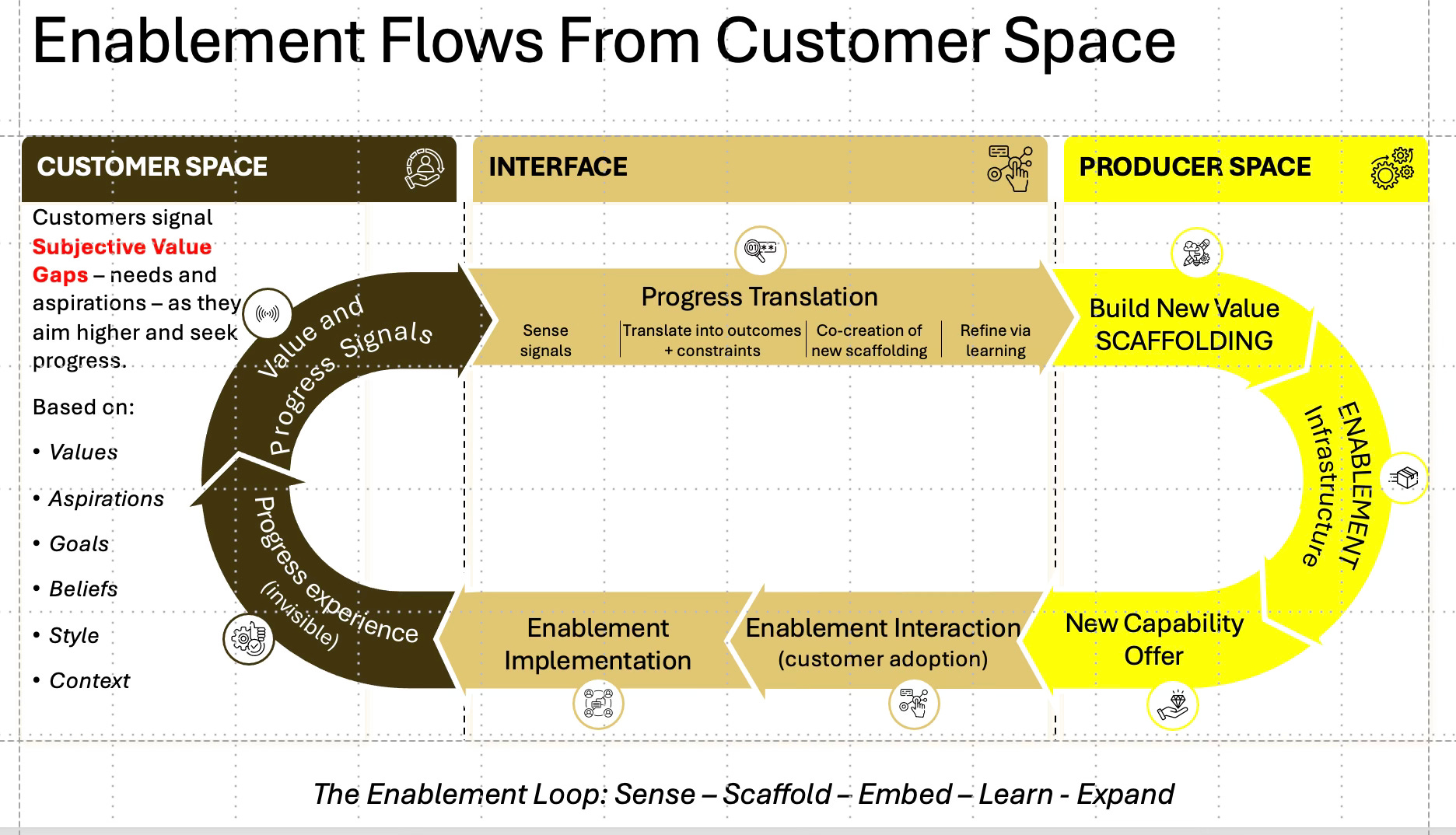
In Part 4, I described the operating model: moving from producer space into customer space, and building the enablement loop:

Sense → Scaffold → Embed → Measure → Learn → Expand.

Now it’s time to zoom out.

Enablement capitalism is not just a business trend or a technology story. It is a moral and institutional upgrade—an improvement in capitalism’s “purpose function.” It changes what capitalism is for, and who it should serve.

And because it changes the logic of value creation, it may also change our politics—especially the role of government.

1) Capitalism’s upgrade: from efficiency and extraction to customer achievement

Managerial capitalism delivered enormous material progress. It also installed a particular worldview: the firm is a production machine, the customer is an endpoint, and success is measured by efficiency in production and extraction in exchange.

In that worldview, customers were rarely granted a place of real superiority. They were “demand,” “segments,” “targets,” “funnels,” “retention cohorts.” Customer value was something to be captured.

This is the deep reason so many firms struggle with enablement. Enablement requires a mindset reversal.

In the value creation era, the customer is not an endpoint. The customer is the site of value creation.

Value is not embedded in products. It is realized by customers as lived experience and tangible progress—when they achieve something that matters to them.

Enablement capitalism makes that explicit and operational:

  • The enterprise does not “deliver value” as a thing, or an identifiable quantity.

  • The enterprise assembles resources and capabilities to enable customer achievement.

  • The economic relationship deepens when customers become more capable—and are able to do more, to achieve more, repeatedly.

This shift is not sentimentality. It’s not about caring. It’s a structural change in what the market selects for.

Under managerial capitalism, firms could win by outproducing, outmarketing, outdistributing—by being more efficient at pushing outputs into markets.

Under enablement capitalism, firms increasingly win by removing customer bottlenecks, barriers and difficulties encountered in customer space. Firms become capability amplifiers. Customers return not because they are locked in or “retained”, but because they are growing.

That is the upgrade: from an economy oriented around extraction to an economy oriented around customer progress.

2) What enablement does to the firm: the end of managerial distance

Managerial capitalism created distance. It organized around internal functions, hierarchies, planning cycles, and control systems. It treated customers as “outside.”

Enablement collapses that distance.

To enable customers, firms must operate in customer space:

  • understand customer workflows and constraints

  • supply scaffolding (templates, workflows, guidance, integrations, agents, embedded expertise)

  • learn from progress signals (time-to-first-win, time-to-competence, market share gains,repeatable outcome rates)

  • decentralize judgment so the organization can adapt at the interface with reality

This is why enablement capitalism aligns naturally with the post-managerial era. You don’t “manage” customers into success. You build systems that help customers succeed—and you build organizations that can learn fast enough to keep doing it.

3) The deep promise: prosperity through capability expansion

If you want a one-line definition of what’s new here, it’s this:

Enablement capitalism is an economy organized around capability expansion.

That sounds abstract until you feel it:

  • A writer becomes a publisher and builds a direct relationship with readers.

  • A small team gains leverage and produces at the level of a large department.

  • A constrained organization gains operational capability under complexity.

  • Individuals learn faster, build faster, decide better, iterate more freely.

This is why AI matters. AI is not merely automation. It is scalable scaffolding: an amplifier of human capability. It can turn aspiration into structured action, and structured action into outcomes. It makes enablement cheaper, faster, and more widely available.

When capability becomes more available, ambition expands. When ambition expands, enablement becomes more valuable. This is the compounding flywheel at the center of the value creation era.

4) The political implication: from regulatory state to enabling state

Now the second theme—the one that may surprise people—is that enablement is not only a business model. It is a governance model.

Most modern governments primarily see themselves as regulators: limiting harm, adjudicating disputes, enforcing rules, preventing failure. Some of that is necessary. But when regulation becomes the dominant stance, it turns society into what Dan Wang has called a lawyerly society—a system optimized for constraint, procedure, risk-avoidance, and permissioning.

Enablement suggests an alternative: an enabling stance.

The question shifts from:

  • “How do we control?”
    to

  • “How do we enable citizens to accomplish what they are trying to accomplish—safely, fairly, and at scale?”

This is not a call for deregulation-as-ideology. It is a call for a different orientation: government as scaffolding rather than government as obstacle.

Think of the contrast as two postures:

Regulatory posture (default today)

  • Prevent error

  • Reduce risk

  • Increase compliance

  • Slow systems down so they can be audited

Enabling posture (the engineering society)

  • Remove bottlenecks

  • Build infrastructure

  • Standardize interfaces

  • Increase capability and throughput while maintaining guardrails

The enabling stance is what engineers do at their best: they don’t primarily adjudicate. They build pathways. They create structures that allow outcomes to happen reliably.

This is the promise of what Dan Wang calls an “engineering society”: not a society run by engineers as a class, but a society shaped by engineering virtues—problem solving, infrastructure building, system improvement, practical iteration, measurable progress.

In enablement capitalism terms, government can learn to operate in citizen space the way enablement firms operate in customer space:

  • sense where people stall

  • build scaffolding and infrastructure

  • measure progress signals

  • iterate and improve

Government becomes less a courtroom and more a workshop.

5) Two guardrails: enablement must not become control or dependency

Every new logic has failure modes, and enablement capitalism has two serious ones.

Failure mode #1: Enablement becomes surveillance

If “operating in customer space” becomes monitoring, nudging, and manipulating, then enablement collapses into control. Customers won’t feel more capable; they’ll feel managed.

Failure mode #2: Enablement becomes dependency

If scaffolding is designed to trap rather than empower—if the customer becomes less capable without the platform—then what looks like enablement becomes extraction in a new disguise.

This is why enablement requires governance by principles: transparency, consent, customer sovereignty, and a commitment to increased capability rather than increased dependence.

The value creation era must be built on trust, or it will be rejected.

6) The simple test of the new era

As we close this series, I’ll offer one simple test of whether you’re seeing enablement capitalism clearly.

Ask of any enterprise—or institution:

Do they leave people more capable than they found them?

Not “more engaged.” Not “more retained.” Not “more monetized.”

More capable. More able to achieve. More able to build. More able to progress.

That is the shift from managerial capitalism’s efficiency-and-extraction logic to the value creation era’s enablement logic.

And if enough enterprises—and enough public institutions—adopt that stance, the next phase of capitalism may be not only more innovative and more productive, but more human: an economy of achievement rather than an economy of capture.

A final note

Parts 3 and 4 (for paid subscribers) provide the practical tools: the Enablement Index and the operating model for customer space. I’ll continue to develop those in future paid essays, along with real case applications and metrics that help organizations measure progress without sliding into bureaucracy.

For everyone: thank you for reading this series. If enablement capitalism is the name of the emerging era, the real work is to build it—carefully, ethically, and in a way that makes people stronger.


The principles of value creation are at the core of Enablement Capitalism. Our online course is here: https://thevaluecreators.mykajabi.com/value-creators

The Post-Managerial Era Of Capitalism (Cambridge University Press)

Venture Mode, the manifesto for Enablement Capitalism (and how to teach it), is available for pre-order on Amazon.


Enablement Capitalism, Part 4: The Practicalities Of Operating in Customer Space

Part 1 of the Enablement Capitalism series named the enablement shift: from outputs to customer accomplishment.
Part 2 explained why it’s emerging now: a new constraint regime shaped by complexity, aspiration, AI-scaled capability, and organizational innovation.
Part 3 provided a diagnostic: the Enablement Index—questions that reveal whether you’re built for customer progress.

The practical question is: how can businesses operate enablement?

The answer is: a new operating model—one that requires a distinctive shift in how a firm sees the world, where it locates value, and how it organizes decision-making.

That shift begins with a deceptively simple idea:

Move to customer space from producer space


Read more